By Marista | Made by Risch
Why a Wonderful Ingredient Might Not Belong in Your Eczema Cream
Let me say this upfront: I love glycerin.
It is one of the most well-researched, well-proven, genuinely remarkable skincare ingredients in existence. It hydrates. It protects. It is gentle, natural, and backed by decades of solid science. I use it in several of our products, and I stand by that completely.
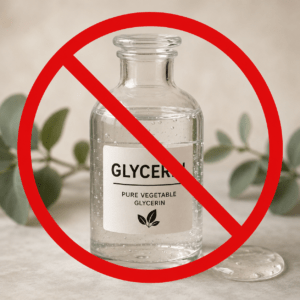
But I do not use it in our Eczema Skin Restoring Jelly.
Because eczema and glycerine do not always mix.
And for a long time, that felt controversial — even to me. Almost every dermatologist recommends it. Almost every eczema moisturiser on the market contains it. The mainstream skincare industry treats glycerin as a near-universal good, especially for dry, compromised skin.
But in my research I came across a research article that showed that glycerin might be contra-indicated for eczema skin. The research showed that it might actually make it worse. By this point in my journey in creating a cream that will work for my son’s eczema, I was desperate. I have tried everything. And despite having used all the right things in my cream, it still did not work.
So I made a batch without glycerin, or vaseline, or mineral oil. The first batch was an absolute disaster! Since I use oils and butters in my cream, with no added ingredients like emolients, emulsifiers, etc. the oils and the butters kept splitting. It looked like a horrifying, oily goo. More research, more batches. And then I succeeded. I created a cream that naturally combined the oils and butters.
But the proof is in the pudding – I had to test this on my son.
I applied the cream to his skin, he had eczema all over – arms, legs, back, stomach, it was heartbreaking. He cried even more when I applied the cream and my heart sank. Did I make a mistake? Am I actually making it worse?
When I say that his eczema was better by the following day, I am not exaggerating. Most of the inflammation on his skin, and the red patches were gone within a week.
It was the glycerin. Because eczema and glycerine don’t always get along.
And the science — once you dig deep enough — explains exactly why.
This article is my honest attempt to lay out both sides of this story fairly, with all the research, all the nuance, and the full truth about glycerin and eczema.
Part One: Why Glycerin is Genuinely Wonderful
Before we get into the controversy, let’s be clear about what glycerin actually is and why it has earned its stellar reputation.
Glycerin (also called glycerol) is a naturally occurring alcohol compound found in all plant and animal tissues, including human skin. It is derived commercially from vegetable oils or as a byproduct of soap-making. It is colourless, odourless, non-toxic, and biodegradable.
Its primary function in skincare is as a humectant — an ingredient that attracts and binds water molecules to the skin. It does this through its hygroscopic nature: glycerin can absorb up to 20% of its own weight in water from the surrounding environment, drawing moisture both from the air and from deeper skin layers into the stratum corneum (the outermost skin layer).
Research has consistently confirmed these benefits:
A major review published in the British Journal of Dermatology (Fluhr et al., 2008) described glycerin as having a holistic role in skin health, noting its ability to improve stratum corneum hydration, enhance skin barrier function, and support the skin’s natural moisturizing factor (NMF) — the collection of compounds the skin naturally produces to stay hydrated.
Research has also shown that glycerin is involved in the activity of aquaporins — the protein channels that regulate the flow of water through skin cells. When functioning normally, this is enormously beneficial: glycerin essentially helps the skin’s own water management system work more efficiently.
A double-blind clinical trial comparing 20% glycerin cream against a urea/sodium chloride cream in 197 patients with atopic dermatitis (Lodén et al., 2002, Acta Dermato-Venereologica) found both equally effective at reducing skin dryness, with glycerin actually causing significantly fewer adverse sensations like smarting — an important finding for people with already irritated eczema skin.
And a placebo-controlled randomized trial specifically in atopic dermatitis (Breternitz et al., 2007, published in Skin Pharmacology and Physiology) confirmed that glycerol-based emollients significantly improved stratum corneum hydration compared to glycerol-free placebo.
So the science supporting glycerin is real, substantial, and not to be dismissed.
For most skin — including dry skin, sensitive skin, normal skin, and skin with mild dryness — glycerin is an excellent, evidence-backed ingredient. Full stop.
Part Two: Where the Story Gets Complicated
Here is where I need you to put on your scientist’s hat and follow me into some more complex territory. Because what happens in eczema skin is not the same as what happens in healthy dry skin — and that difference matters enormously.
The AQP3 Problem
I mentioned aquaporins above — the protein channels that regulate water flow in skin. In healthy skin, a specific aquaporin called AQP3 (Aquaporin-3) is expressed at low, controlled levels, mainly in the basal layer of the epidermis. It quietly and efficiently transports water and glycerol across cell membranes, helping to keep the skin hydrated.
AQP3 is also the channel through which topically applied glycerin is transported into and through the skin. Under normal circumstances, this is exactly what you want.
But in eczema skin, this system is broken.
Multiple peer-reviewed studies have now confirmed that AQP3 is significantly upregulated — overexpressed — in atopic dermatitis lesions. A gene microarray study by Olsson et al. (2006, Allergy) analyzed skin biopsies from 10 eczema patients and 10 healthy controls and found that AQP3 was among the most notably upregulated genes in eczema skin, with strong AQP3 staining found throughout both the stratum basale and stratum spinosum — layers where it barely appears in healthy skin.
The study’s conclusion: “Increased expression and altered cellular distribution of AQP3 is found in eczema and this may contribute to water loss.”
This was confirmed and expanded by Nakahigashi et al. (2011, Journal of Investigative Dermatology), who found significantly increased AQP3 transcript and protein expression in the epidermis of human atopic dermatitis lesions — and noted that this upregulation contributed to increased transepidermal water loss (TEWL) and epidermal hyperplasia.
A third research group, summarized in a review published in the International Journal of Molecular Sciences (2022), confirmed: “Nakahigashi et al. found a significant increase in AQP3 expression on keratinocyte membranes in AD skin lesions compared to a healthy control epidermis.”
To understand why this matters for glycerin, you need to understand one critical fact: AQP3 is a glycerol transporter. It doesn’t just move water — it specifically moves glycerol (glycerin) and water together.
In healthy skin, low AQP3 expression means controlled, beneficial glycerol transport.
In eczema skin, with AQP3 overexpressed and distributed throughout more skin layers than it should be, this system is dysregulated. The channel is, in a sense, stuck open and overactive. And the connection between elevated AQP3 activity and elevated TEWL in eczema skin suggests that an already malfunctioning glycerol transport system may not be the right target for additional topical glycerol — you may be pouring water into an already leaking pipe.
The Filaggrin Connection
The plot thickens further. In 2013, a study published in PLOS ONE (Guo et al.) examined the AQP3-Notch1 axis in keratinocyte differentiation and found something striking: when AQP3 expression is elevated — as in atopic dermatitis — it leads to decreased expression of filaggrin, one of the most critical proteins in skin barrier formation.
The researchers wrote: “Its increased expression, as observed in atopic dermatitis, led to decreased expression of an important epidermal barrier component, filaggrin, and increased expression of pro-inflammatory cytokines, including TNFα and CCL5.”
Filaggrin deficiency is already considered a primary driver of atopic dermatitis. The finding that overexpressed AQP3 — the very channel that transports glycerin — further suppresses filaggrin production adds another layer of complexity to the question of whether flooding this system with additional topical glycerol is therapeutic or counterproductive in active eczema.
Part Three: The Clinical Evidence That Didn’t Get Enough Attention
Recall the Breternitz et al. (2007) study I mentioned earlier — the one that confirmed glycerol improved stratum corneum hydration in atopic dermatitis? That study is frequently cited as proof of glycerin’s benefit in eczema. And the hydration finding is real.
But here’s what often gets left out of the summary.
The study also found: “No significant differences were detectable for erythema values, SCORAD and local severity between the glycerol-containing cream and placebo.”
The SCORAD (Scoring Atopic Dermatitis) is the gold standard clinical measure of eczema severity — it captures redness, oozing, excoriation, lichenification, dryness, and itch. The finding that glycerin improved surface hydration but did not improve actual eczema severity compared to a glycerin-free control is a significant detail.
Both groups improved over time — which the researchers noted simply confirms that “the importance of emollient treatment in AD” matters, regardless of glycerin content. In other words, the carrier cream itself helped. The glycerin didn’t add measurable clinical benefit over and above the base formula.
A systematic review of moisturizers in atopic dermatitis (van Zuuren et al., 2017) additionally noted that “glycerin studies were more often associated with a high risk of bias” compared to urea studies — meaning the positive evidence for glycerin in eczema is less robust than commonly believed.
Part Four: The Sensitisation Risk
There is a fourth dimension to this discussion that is less mechanistic and more practical — and it is relevant specifically to eczema patients.
Glycerin is considered hypoallergenic and is even used as a negative control in standard allergy patch tests, because reactions to it are genuinely rare. But rare does not mean impossible — and eczema skin, with its compromised barrier, is at significantly higher risk of developing sensitisation to any topical agent than healthy skin.
Hannuksela’s research, cited in multiple dermatology publications, involved patch testing several thousand dermatology patients with glycerin. Results were negative in virtually all cases — but in the cases where they were positive, the patients had developed widespread dermatitis from creams containing glycerin as an ingredient, and their patch tests confirmed glycerin as the culprit (Hannuksela, 1979, International Journal of Cosmetic Science; Finch et al., 2003, Contact Dermatitis).
A 2016 case report published in the Journal of the American Academy of Dermatology (Namiki et al.) documented contact urticaria syndrome caused by glycerin — and noted that in all previously reported cases of glycerin sensitisation, the affected patients had pre-existing eczematous skin conditions.
This is the pattern: healthy skin tolerates glycerin well. Compromised, inflamed, eczema-affected skin — with its reduced barrier and heightened permeability — is the population in which the rare but real sensitisation reactions occur.
Part Five: Why I Removed It — And What Replaced It
When I was developing our Eczema Skin Restoring Jelly, I included glycerin initially for the same reasons everyone does: it’s a proven humectant, it’s gentle, it supports hydration. The cream moisturised. It felt good.
But the eczema didn’t improve the way I needed it to. The product hydrated the surface, but it didn’t change the underlying condition.
When I removed glycerin from the formula, something shifted. The cream worked better. It wasn’t just moisturising — it was helping the skin heal.
At the time, I had stumbled across early research on AQP3 and glycerol transport in eczema skin. I couldn’t find it again easily because this was an emerging body of literature, published in specialised immunology and dermatology journals rather than mainstream skincare sources. But the hypothesis made sense of what I was observing: in eczema skin with dysregulated AQP3 channels, adding more glycerol to the system may not help — and may, in some patients, aggravate the dysfunction.
The humectant role glycerin plays was replaced by urea — which is the superior choice for eczema skin for several reasons.
Urea works through a completely different mechanism. Rather than relying on transport channels, urea binds directly to keratin proteins in the skin, acting as a hygroscopic molecule that holds water within the skin structure itself. It is a natural component of the skin’s own NMF. Multiple clinical trials have shown urea-containing formulas produce significant clinical improvement in eczema severity, TEWL, roughness, and hydration — not just surface moisture measurements.
Urea also acts as a penetration enhancer, helping every other active ingredient in the formula reach deeper skin layers where the real repair work needs to happen. It is, in short, a more targeted tool for the specific pathology of eczema than glycerin.
The Bottom Line: Context is Everything
The truth about glycerin and eczema is not that glycerin is bad. It isn’t. Glycerin is a genuinely excellent ingredient for most skin purposes.
The truth is more nuanced than that:
For most skin types, including dry skin, sensitive skin, and general daily moisturisation, glycerin is outstanding — safe, effective, and well-supported by research.
For eczema skin specifically, the picture is more complicated. The same AQP3 channels that make glycerin so effective in healthy skin are dysregulated in eczema, potentially turning a benefit into a problem. Clinically, glycerin improves surface hydration in eczema but has not been shown to improve actual eczema severity scores. And the small but real sensitisation risk is concentrated precisely in the eczema population — compromised-barrier skin that absorbs topical agents more readily than healthy skin.
This is not a mainstream position. Most dermatologists still recommend glycerin for eczema, and the studies supporting it are real. I am not asking you to dismiss them.
I am asking you to consider that the absence of improvement I observed, and eventually traced to glycerin through formulation testing, has a scientifically plausible explanation — one that is increasingly supported by the molecular biology of AQP3 dysregulation in atopic dermatitis.
Science is not static. The mainstream consensus on glycerin for eczema was formed before the detailed AQP3 research existed. As that literature matures, I believe the nuance will become more widely recognised.
For now, our Eczema Skin Restoring Jelly is glycerin-free — not because glycerin is bad, but because it is the wrong tool for this specific job. And the results speak for themselves.
A Note on Transparency
This article is not to make any scientific claims, bash any studies, or try to justify my products.
It is not a claim that glycerin is harmful or should be avoided by everyone with eczema. It is not a condemnation of any product or brand that uses glycerin in eczema formulas. And it is not settled science — the AQP3 story in particular is still an active area of research with some conflicting findings.
What it is, is an honest account of my formulation journey, the clinical observation that drove a formula change, and the emerging research that explains that observation. It is my belief that our customers deserve to understand not just what is in our products, but why — and why some things that work everywhere else don’t belong here.
If you are using a glycerin-containing moisturiser for your eczema and it is working well for you, please continue using it. Every person’s skin is different, every eczema presentation is different, and what matters is what works for your skin.
But if you have been using glycerin-containing products and wondering why the eczema persists despite feeling moisturised on the surface — this article may offer a direction worth exploring.
Selected References
- Olsson, M., et al. (2006). Increased expression of aquaporin 3 in atopic eczema. Allergy, 61(9), 1132–1137. doi:10.1111/j.1398-9995.2006.01151.x
- Nakahigashi, K., et al. (2011). Upregulation of aquaporin-3 is involved in keratinocyte proliferation and epidermal hyperplasia. Journal of Investigative Dermatology, 131(4), 865–873.
- Guo, L., et al. (2013). An Aquaporin 3-Notch1 axis in keratinocyte differentiation and inflammation. PLOS ONE, 8(11), e80179.
- Breternitz, M., et al. (2007). Placebo-controlled, double-blind, randomized, prospective study of a glycerol-based emollient on eczematous skin in atopic dermatitis. Skin Pharmacology and Physiology, 21(1), 39–45.
- Lodén, M., et al. (2002). A double-blind study comparing the effect of glycerin and urea on dry, eczematous skin in atopic patients. Acta Dermato-Venereologica, 82(1), 45–47.
- Fluhr, J.W., et al. (2008). Glycerol and the skin: holistic approach to its origin and functions. British Journal of Dermatology, 159(1), 23–34.
- Hannuksela, M. (1979). Allergic and toxic reactions caused by cream bases in dermatological patients. International Journal of Cosmetic Science, 1(5), 257–263.
- Finch, T.M., et al. (2003). Allergic contact dermatitis from glycerin in a moisturizing cream. Contact Dermatitis, 48(5), 285.
- Namiki, T., et al. (2016). Contact urticaria syndrome and protein contact dermatitis caused by glycerin enema. JAAD Case Reports, 2(2), 110–112.
- van Zuuren, E.J., et al. (2017). Emollients and moisturisers for eczema. Cochrane Database of Systematic Reviews, 2, CD012119.
- Pan, M., et al. (2013). Urea for topical application in skin disorders. Journal of the European Academy of Dermatology and Venereology, 27(6), 657–675.
