
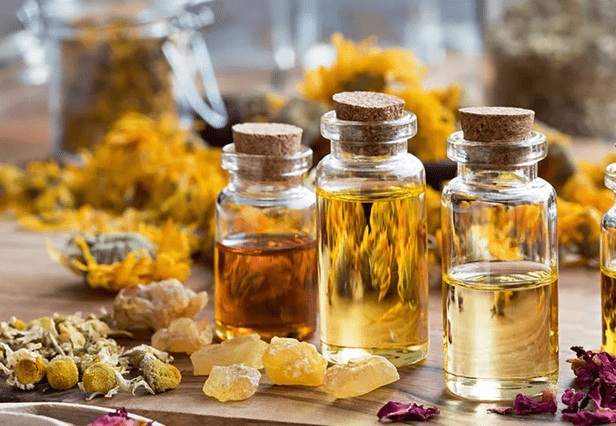
Essential Oils: Drawing Back the Curtain
A while ago, I was invited to an essential oil party. Think Tupperware party, but instead of plastic containers, the host was selling beautifully packaged bottles of essential oils at prices that made my eyes water. The woman presenting was enthusiastic, I’ll give her that. But the information she shared was, at best, incomplete, and at worst, dangerously misleading. She spoke with absolute conviction about oils “curing” conditions, about ingesting them freely, and about layering them directly on skin without dilution. Not once did she mention safety, contraindications, or the very real limits of what the science actually supports. What frustrated me most was not the sales pitch. It was the realization that this is incredibly common. People share posts, attend parties, and buy into claims without verifying a single one. And because I use essential oils in several of my own products, I have spent considerable time researching them properly. So let’s do this right. Here is what you actually need to know about essential oils. A Brief History Essential oils are far from a modern wellness trend. Their use spans thousands of years across multiple civilizations. Ancient Egyptians used aromatic plant extracts in religious rituals, embalming, and medicine as far back as 3500 BCE. They employed a rudimentary form of infusion, soaking plant material in oils or fats to extract aromatic compounds. Evidence of distillation-like processes has also been found in Mesopotamia dating to around 3000 BCE. In ancient India, the Ayurvedic tradition incorporated aromatic plant extracts into medicine and ritual for millennia. Traditional Chinese medicine similarly used plant-based aromatics extensively. In ancient Greece and Rome, physicians including Hippocrates and Dioscorides documented the medicinal use of plant extracts, with Dioscorides’ work De Materia Medica becoming a foundational medical text for centuries. The term “essential oil” itself is believed to derive from “quintessential oil,” rooted in the Aristotelian concept of the “fifth essence” or quintessence – the spirit or life force of a plant. The process of steam distillation, which remains the most common method of production today, was refined and documented by Persian physician Avicenna (Ibn Sina) around the 10th and 11th centuries CE, and his contributions laid the groundwork for modern essential oil production. The modern aromatherapy movement began in the early 20th century, largely attributed to French chemist René-Maurice Gattefossé, who coined the term “aromatherapy” in 1937 after reportedly discovering the burn-soothing properties of lavender oil firsthand. Since then, the industry has grown into a multi-billion dollar global market, with all the benefits and pitfalls that follow. How Are Essential Oils Made? Not all essential oils are produced the same way. The method used depends on the plant material involved, and each method has implications for the quality and chemical composition of the resulting oil. Steam Distillation The most widely used method. Steam is passed through plant material, causing the volatile aromatic compounds to evaporate. The steam and aromatic vapour are then cooled and condensed, separating into water (hydrosol) and oil. Lavender, peppermint, tea tree, and eucalyptus oils are typically produced this way. Cold Pressing (Expression) Used primarily for citrus oils. The rind of the fruit is mechanically pressed or punctured to release the aromatic oils. Because no heat is involved, the resulting oil retains a fresher, more vibrant profile. Lemon, orange, bergamot, and grapefruit oils are produced this way. These oils are also more prone to phototoxicity – an important safety consideration. Solvent Extraction Used for delicate flowers that cannot withstand steam distillation, such as jasmine, rose, and neroli. A chemical solvent (often hexane) is used to extract the aromatic compounds, producing what is called a “concrete,” which is then processed with alcohol to yield an “absolute.” These are highly concentrated and largely used in perfumery. Solvent residues, though minimal in the final product, are a consideration for therapeutic use. CO₂ Extraction A newer method using carbon dioxide under high pressure to extract aromatic compounds. It produces oils with a fuller chemical profile and no solvent residue. Frankincense and ginger are sometimes extracted this way. It is considered a premium method, and the oils produced are generally of high quality, though the cost reflects this. The Science Behind Essential Oils: What Do We Actually Know? This is where things get complicated, and where honest conversation becomes important. Essential oils do contain biologically active compounds. Many of them have demonstrated real pharmacological properties in laboratory settings, including antimicrobial, anti-inflammatory, antioxidant, and antifungal activity. The challenge is the significant gap between what happens in a petri dish and what happens on or in the human body. The evidence base for essential oils is, in general, considered preliminary. Many studies are small, lack rigorous controls, or are conducted in vitro (in a lab) rather than in vivo (in living subjects). That does not mean essential oils are ineffective. It means we need to be precise about what we claim, and what we do not yet know. The National Institutes of Health (NIH) and other major health bodies acknowledge that some essential oils show genuine therapeutic promise, while cautioning against overstating what current research can support. Overstated Claims: Where the Evidence Falls Short Some of the most aggressively marketed claims around essential oils are precisely the ones with the weakest scientific support. Underappreciated Claims: Where the Evidence Is Stronger It would be equally dishonest to dismiss essential oils entirely. Several have accumulated meaningful research support for specific applications. How to Use Essential Oils Topically: A Practical Guide Topical application is one of the most common and studied uses of essential oils. It is also one of the most commonly misused. Here is what you need to know. Always dilute Essential oils must be diluted in a carrier oil before application to the skin. Applying them neat (undiluted) risks chemical burns, sensitization, and allergic reactions. The standard guideline from the National Association for Holistic Aromatherapy (NAHA) is: Suitable carrier oils include jojoba, sweet almond, fractionated coconut, or grapeseed oil. Avoid applying essential oils to broken or irritated skin. Patch
Essential Oils: Drawing Back the Curtain Read More »
